
Go API
Stdlib net/http, zero frameworks. 7 middleware layers (CORS, auth, rate limit, metrics, request ID, body limit, timeout). Multi-stage Docker image at 24.7MB. 80+ tests with -race, CI on every push.
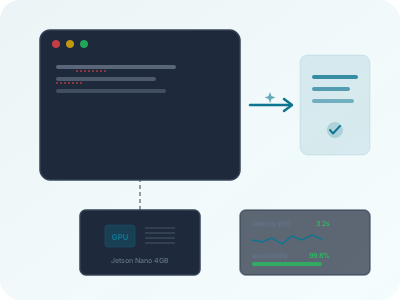
Cloud LLM APIs see everything you type. Every email draft, every Slack message, every document revision — routed through third-party servers, logged, and used for training. You trade privacy for convenience.
Pollex runs a quantized language model on a $99 Jetson Nano with 4GB of RAM sitting on your desk. The Chrome extension sends your text through a Cloudflare Tunnel to a Go API that calls llama.cpp with full CUDA offload. The result comes back in 3-8 seconds, reading like a fluent non-native speaker — professional and clear, never AI-flavored.
Go API
Stdlib net/http, zero frameworks. 7 middleware layers (CORS, auth, rate limit, metrics, request ID, body limit, timeout). Multi-stage Docker image at 24.7MB. 80+ tests with -race, CI on every push.
Chrome Extension
Manifest V3 service worker. Paste text, pick a model, get polished output, copy it. Persistent job recovery across popup opens. 7-entry history. Works from anywhere through Cloudflare Tunnel.
GPU Inference
llama.cpp on Jetson Nano 4GB — 128 Maxwell cores, CUDA 10.2, full GPU offload. Qwen 2.5 1.5B quantized to Q4_0 (~1GB VRAM). Sustained ~4 tok/s. Short text polished in ~3s, medium in ~8s.
Observability
Prometheus metrics with 4 custom collectors. 6 alerting rules tied to SLO targets. Grafana dashboard auto-provisioned on startup. k6 load test scripts for burst, sustained, and soak scenarios.
Browser Extension --> Cloudflare Tunnel --> Go API (:8090) --> llama-server (CUDA) --> Qwen 2.5 1.5B Manifest V3 pollex.mlorente.dev 7 middleware full GPU offload Q4_0 · ~1GB| Layer | Tech | What it does |
|---|---|---|
| Extension | Chrome Manifest V3 | Paste text, select model, copy result |
| Tunnel | Cloudflare Tunnel | Zero-config HTTPS ingress — Jetson sits behind double NAT |
| API | Go 1.26, stdlib net/http | Routes requests to LLM backends, enforces auth and rate limits |
| Inference | llama.cpp + Qwen 2.5 1.5B Q4_0 | GPU inference on 128 Maxwell cores at ~4 tok/s |
| Monitoring | Prometheus + Alertmanager + Grafana | SLO tracking, burn-rate alerts, auto-provisioned dashboards |
Measured on Jetson Nano 4GB, Qwen 2.5 1.5B Q4_0, full GPU offload (-ngl 999), 128 Maxwell cores.
| Input | Chars | Latency | Throughput |
|---|---|---|---|
| Short (one sentence) | ~50 | ~3s | ~4 tok/s |
| Medium (paragraph) | ~500 | ~8s | ~4 tok/s |
| Long (full page) | ~1000 | ~16s | ~4 tok/s |
SLO targets (7-day rolling window):
| Metric | Target |
|---|---|
| Availability | 99% (error budget: 100.8 min/week) |
| Latency p50 | under 20s |
| Latency p95 | under 60s |
| Error rate (5xx) | under 1% |
Load tested with k6 — burst (5 VUs, 25 iterations), sustained (12 req/min for 2 min), and 30-minute soak runs.
Seven middleware layers, applied in order:
| Layer | Limit | Response |
|---|---|---|
| API key auth | X-API-Key, constant-time compare | 401 |
| Request body | 64KB max | 413 |
| Text length | 10,000 chars | 400 |
| Rate limit | 10 req/min/IP, sliding window | 429 |
| Timeout | 120s per request | 504 |
Authenticated requests bypass rate limiting — by design, since API key holders are trusted. The system prompt includes injection guardrails: user input is always treated as text to polish, never as instructions.
No GPU, no Jetson, no external services. The mock adapter returns canned responses:
git clone https://github.com/mlorentedev/pollex.gitcd pollexmake dev # API on :8090 with mock adaptercurl -s http://localhost:8090/api/health | python3 -m json.tool| Language | Go 1.26, stdlib net/http |
| Dependencies | yaml.v3, prometheus/client_golang |
| Tests | 80+ with subtests, -race clean, go vet clean |
| Docker | 24.7MB (multi-stage Alpine 3.21, non-root) |
| CI/CD | Lint + test + build on push, goreleaser on tags |
| License | MIT |
| Hardware | Jetson Nano 4GB — ARM64, CUDA 10.2, 128 Maxwell cores |